
CTR Manipulation: The Complete Guide to Boosting Your Rankings with Real Clicks
CTR manipulation is the practice of increasing your organic click-through rate on Google to improve search rankings. It works because Google uses click data — confirmed through their own NavBoost system — to decide which results deserve higher positions. But there is a critical catch: Google can detect and ignore bot clicks. Only real human clicks move the needle.
SerpClix is the only CTR manipulation service built entirely on real human clickers — over 400,000 of them worldwide. No bots. No browser emulators. No scripts. Just real people searching Google, finding your listing, clicking, and spending meaningful time browsing your site naturally.
Start Your Free Trial →What Is CTR Manipulation?
Click-through rate manipulation is the deliberate process of increasing the percentage of searchers who click on your listing in Google's search results. When more people click on your result — and stay on your site — Google interprets that as a strong relevance signal. Over time, your ranking improves.
Here is a simple example. Suppose your page sits at position 6 for the keyword "best accounting software." The average CTR for position 6 is roughly 3–4%. If you can push that CTR to 8–10% — well above the expected rate for that position — Google's algorithms notice. They test your result in higher positions. If click behavior stays strong, the ranking sticks.
The CTR-to-Rankings Feedback Loop
CTR manipulation exploits a powerful feedback loop that already exists in Google's ranking system:
- Higher CTR signals relevance. Google measures how often users click your result versus competitors. A higher-than-expected CTR tells Google your page satisfies searcher intent.
- Google promotes high-CTR results. The algorithm tests your page at higher positions. If the engagement holds, the promotion becomes more permanent.
- Higher positions generate more organic CTR. Position 1 gets roughly 10x the clicks of position 10. Once you rank higher, your natural CTR increases, compounding the effect.
- More traffic generates more signals. With higher rankings come more visitors, more backlinks, more brand searches — all of which reinforce the ranking.
This is not a theory. It is the documented behavior of Google's search engine, confirmed by leaked internal documents, patent filings, and testimony in the DOJ antitrust trial.
Organic CTR vs. Paid CTR
It is important to distinguish between organic CTR manipulation and paid click fraud. CTR manipulation targets organic search results — the free, natural listings that appear below ads. It is about influencing Google's organic ranking algorithm. This is fundamentally different from clicking on Google Ads, which is click fraud and carries legal consequences.
Every strategy discussed in this guide relates exclusively to increasing organic traffic through improved organic rankings. SerpClix's clickers only interact with organic search results, never paid ads.
The Evidence: Why CTR Moves Rankings
For years, Google publicly downplayed the role of click data in rankings. That changed dramatically in 2023 and 2024, when a series of revelations confirmed what many SEOs had long suspected: clicks are one of the most important ranking factors in Google Search.
NavBoost: Google's Click-Based Ranking System
During the DOJ antitrust trial against Google in 2023, former Google engineer Eric Lehman testified under oath that click data is used in ranking. The system responsible is called NavBoost, and it has been active since 2005 — nearly two decades of click-based ranking adjustments.
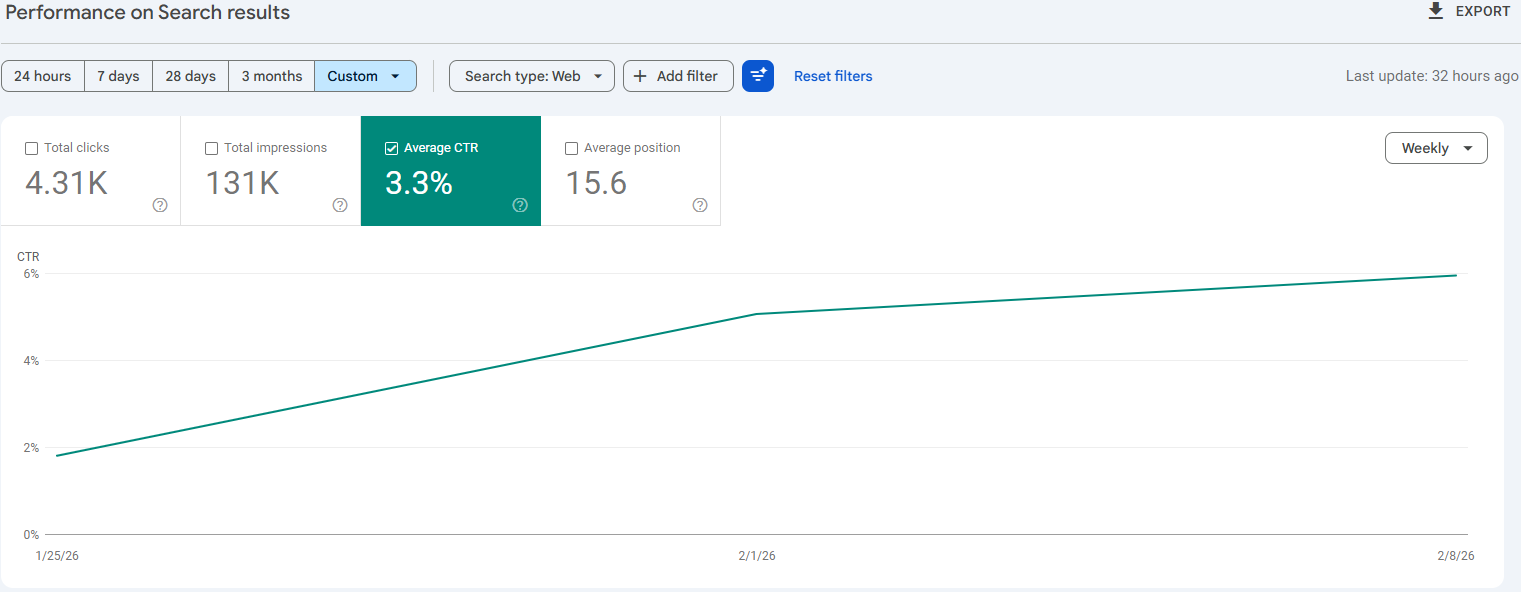
NavBoost analyzes user click behavior on search results to determine which pages best satisfy queries. It tracks metrics including:
- Click-through rate — How often a result gets clicked relative to impressions
- Long clicks vs. short clicks — Whether users stay on the page (good) or bounce back immediately (bad)
- Last click — Whether your page was the final result the user visited, suggesting it fully answered their question
- Click patterns across devices — Desktop vs. mobile behavior
This is not speculation. It is sworn testimony from Google's own engineers. NavBoost processes trillions of clicks to determine which results deserve higher or lower rankings. Learn more about how you can leverage this on our NavBoost SEO page.
The Google API Leak (May 2024)
In May 2024, thousands of pages of internal Google API documentation were accidentally leaked. These documents revealed that Google tracks a metric called NavBoost clicks and uses click signals in ways far more extensive than they had ever publicly admitted.
The leak confirmed the existence of click-based ranking features including "goodClicks," "badClicks," "lastLongestClicks," and per-URL click data segmented by device type. This was the most definitive proof that CTR directly affects organic SEO rankings.
Rand Fishkin's Click Experiment
Rand Fishkin, the co-founder of Moz and SparkToro, conducted a now-famous experiment. He asked his Twitter followers to search for a specific query on Google and click on a particular result. Within hours, that result jumped from a lower position to the number-one spot.
While Fishkin's experiment was informal, it demonstrated a powerful principle: a sudden burst of clicks from real users on a specific search result can rapidly influence its ranking. Google's algorithm responded to the click signal in near real-time.
The Sterling Sky Local SEO CTR Experiment
In one of the most carefully controlled CTR experiments ever published, Sterling Sky tested whether manipulating organic click-through rate could move local search rankings. The results were striking: targeted clicks consistently moved rankings upward, with some results jumping several positions within days.
This experiment was particularly significant because it used controlled methodology and focused on local SEO — demonstrating that local SEO CTR manipulation is just as effective as traditional organic CTR manipulation.
Google's Trust Score Patent
Google holds multiple patents related to using click behavior to evaluate page quality and authority. One patent describes a "trust score" system that uses click behavior to assess authority. Pages that receive consistent, high-quality clicks from real users over time accumulate higher trust scores, making them more likely to rank well.
These patents describe exactly what an effective CTR manipulation strategy aims to achieve: consistent, natural-looking click patterns that signal genuine user interest and satisfaction.
The Evidence Is Clear: Clicks Move Rankings
NavBoost, the DOJ trial, the API leak, independent experiments — the data is overwhelming. The question is not whether CTR affects rankings. It is how to increase your CTR effectively and safely.
Start Your Free Trial →How CTR Manipulation Works: A Step-by-Step Breakdown
Understanding the mechanics of SERP CTR manipulation helps you evaluate different approaches and choose the right one. Here is how the process works when done correctly with a service like SerpClix:
Select your target keywords
You identify the keywords where you want to improve rankings. These might be keywords where you already rank on page 1–2 but want to move higher, or competitive terms where you need an edge. Focus on keywords tracked in Google Search Console so you can measure improvement.
Specify your target URLs and set click volume
For each keyword, you designate the specific page on your site that should receive clicks. This is the URL that currently appears (or should appear) in Google's search results for that keyword. You configure how many clicks per day you want for each keyword. The best approach is to start conservatively and ramp up gradually, mimicking natural traffic growth. Sudden spikes in CTR look unnatural.
Real humans search, click, and browse
Actual people — not bots — open Google in their regular browser, type in your target keyword (or a variation), and browse the search results naturally. The clicker scrolls through the results, finds your URL, and clicks on it — exactly as a genuine searcher would. This is critical: the clicker remains on your site for extended time, scrolling through content, clicking internal links, and browsing naturally. This meaningful dwell time sends a powerful "long click" signal to Google's NavBoost system.
Google's algorithm registers the engagement. NavBoost processes the click data. Your page shows a higher-than-expected CTR and strong dwell time for this keyword. The algorithm begins testing your page at higher positions. Over days and weeks, your rankings rise as the accumulated click signals build. You monitor progress through Google Search Console and your rank tracking tools.
The entire process depends on one fundamental requirement: the clicks must come from real humans using real browsers on real devices. Google's spam detection systems are extraordinarily sophisticated. Bot clicks, automated scripts, and browser emulators are detected and discounted. This is why the choice between bot-based tools and real human clicks matters enormously — and it is the reason SerpClix exists.
CTR Bots vs. Real Human Clicks: Why Bots Fail
The CTR manipulation tool market is filled with services that promise thousands of clicks for a few dollars. Almost all of them use bots — automated scripts running in headless browsers or virtual machines. And almost all of them fail to produce lasting ranking improvements. Here is why.
How Google Detects Bot Clicks
Google has invested billions of dollars in fraud detection technology, originally developed to protect their advertising platform. These same systems analyze organic search behavior. Google detects bots through:
- Browser fingerprinting. Google checks hundreds of browser attributes — installed fonts, screen resolution, WebGL rendering, Canvas fingerprint, audio context, timezone, language settings, and more. Headless browsers and virtual machines have telltale fingerprints that differ from real browsers.
- Behavioral analysis. Real humans exhibit natural mouse movements, variable scroll speeds, random pauses, and imperfect click targets. Bots produce mechanically precise, repetitive patterns that statistical models easily identify.
- IP reputation. Bot traffic typically comes from data centers, VPNs, and proxy networks. Google maintains extensive databases of known non-residential IP addresses. Even "residential proxies" often cycle through flagged addresses.
- Cookie and session analysis. Real users have Google accounts, browsing histories, cookies from previous sessions, and established search patterns. Bot sessions start clean — no history, no cookies, no Google account — which is a massive red flag.
- Cross-signal validation. Google correlates click data with Chrome browsing data, Android usage data, Google account activity, and other signals. A "user" who only exists during CTR manipulation sessions has no corroborating signals.
When Google's systems flag clicks as artificial, those clicks are simply discarded. They do not count toward NavBoost calculations. In some cases, detected manipulation can trigger manual review of the target site, creating risk with no reward. This is why organic traffic bots consistently underperform real human click services.
SerpClix vs. Bot-Based CTR Tools: Comparison Table
| Feature | SerpClix | Bot-Based Tools |
|---|---|---|
| Click source | ✓ Real humans (400,000+) | ✗ Bots / scripts / emulators |
| Browser type | ✓ Real browsers (Chrome, Firefox, Safari) | ✗ Headless or modified browsers |
| IP addresses | ✓ Residential IPs worldwide | ✗ Data centers / proxy networks |
| Google account history | ✓ Real accounts with search history | ✗ No accounts or fake accounts |
| Mouse / scroll behavior | ✓ Natural, human patterns | ✗ Scripted, repetitive patterns |
| Dwell time | ✓ Extended real browsing time | ✗ Simulated or minimal |
| Geographic targeting | ✓ Specific countries, states, cities | ✗ Proxy-based (often detected) |
| Browser fingerprint | ✓ Unique, legitimate fingerprints | ✗ Generic / detectable fingerprints |
| Detection risk | ✓ Minimal — indistinguishable from real traffic | ✗ High — Google actively filters bot clicks |
| Ranking impact | ✓ Proven results (see case studies) | ✗ Temporary or none |
| Competitors | — | ✗ Bot-Based Services |
Bot-based alternatives all rely on automated bot traffic. They may offer large click volumes at low prices, but those clicks lack the authenticity signals that Google's NavBoost system requires. SerpClix is the only SERP click service that uses exclusively real human clickers — and that distinction is the difference between results and wasted budget.
Stop Wasting Money on Bot Clicks
Only real human clicks move rankings. SerpClix is the only CTR manipulation service built on 400,000+ real clickers worldwide.
Start Your Free Trial →How SerpClix Delivers Real CTR Manipulation
SerpClix was built from the ground up to solve the fundamental problem with CTR manipulation: Google ignores bot clicks. Instead of trying to outsmart Google's detection systems with better bots, SerpClix took a completely different approach — real humans.
The SerpClix Clicker Network
SerpClix has built a global network of over 400,000 real human clickers. These are real people — freelancers, remote workers, students — who install the SerpClix browser extension and complete click orders as a side job. They use their own personal computers, their own home internet connections, and their own browsers with real browsing histories and Google accounts.
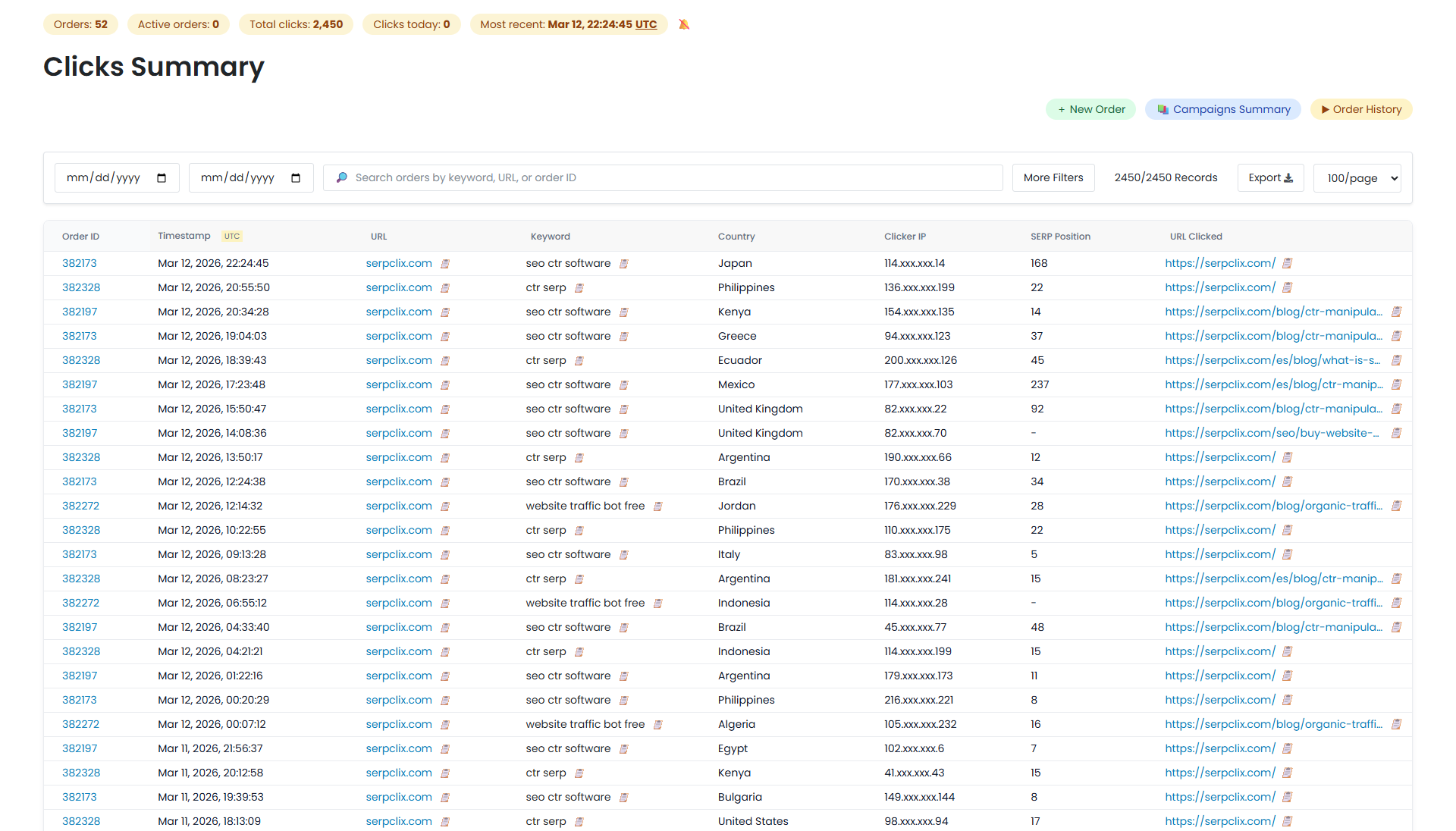
This means every click from the SerpClix network is:
- From a unique residential IP address — not a data center, VPN, or proxy
- From a real browser with a legitimate fingerprint, installed extensions, browsing history, and cookies
- From a real Google account with years of search history and activity
- With natural behavior — real mouse movements, realistic scroll patterns, genuine page interaction
- With substantial dwell time — clickers stay on your site for meaningful time, browsing multiple pages
To Google's systems, a SerpClix click is indistinguishable from any other genuine user visit. Because it is a genuine user visit.
Geographic Targeting
SerpClix allows you to target clicks from specific geographic locations. Need clicks from users in Texas for a local SEO campaign? SerpClix assigns your order to clickers in Texas. Targeting the UK market? SerpClix routes your order to UK-based clickers.
This geographic precision is essential for local SEO and for businesses targeting specific markets. Google's NavBoost system weighs click data by geography — clicks from your target market carry more relevance than clicks from irrelevant locations.
Natural Click Patterns
SerpClix distributes clicks throughout the day using natural timing patterns. Rather than delivering all clicks in a single burst (which would look suspicious), clicks are spread across different times, with slight variations in daily volume. This mimics the natural ebb and flow of organic search traffic.
You have full control over daily click volume, and SerpClix's platform provides guidance on optimal click levels based on your keyword's existing traffic volume. The goal is always to produce click patterns that look entirely organic to Google Search Console and to Google's internal systems.
The Complete SerpClix Process
Create your account and add keywords
Sign up for a free trial at SerpClix.com. Enter the keywords and target URLs you want to rank for. Configure your campaign — set daily click volume and geographic targeting. The system handles visit duration automatically.
Clickers fulfill your orders
Real humans from our 400,000+ network search your keywords on Google and click your listings. They stay and browse your site naturally for meaningful time.
Monitor and scale your results
Track ranking changes through the SerpClix dashboard, Google Search Console, and your preferred rank tracker. Increase click volume or add more keywords as you see results.
Most customers see measurable ranking improvements within 7–14 days. Some highly competitive keywords may take longer, while lower-competition terms often respond within days. You can learn more about the broader strategy behind buying organic traffic and how it fits into a comprehensive SEO plan.
Case Studies: Real CTR Manipulation Results
Theory is important, but results matter more. Here are three documented case studies from SerpClix customers who used real human clicks for SEO to achieve measurable ranking improvements.
Case Study #1: Nova Solutions — 7 URLs, All Improved Within 13 Days
Nova Solutions, a digital marketing agency, tested SerpClix across 7 different client URLs spanning multiple industries and keyword difficulties. Every single URL improved in ranking within 13 days of starting the campaign. The consistency across different niches demonstrated that CTR manipulation with real human clicks works regardless of industry — the underlying mechanism (NavBoost) is the same for every search query.
The most notable result was a competitive B2B keyword that had been stuck at position 8 for months despite ongoing content optimization and link building. After 13 days of targeted clicks from SerpClix, it moved to position 3 — a jump that generated a 340% increase in organic traffic for that keyword.
Case Study #2: Coreter Media — Position 4.7 to Position 1.7 in 7 Days
Coreter Media ran a focused CTR manipulation campaign on a single high-value keyword. Starting from an average position of 4.7 in Google Search Console, the page climbed to an average position of 1.7 in approximately one week. This 3-position improvement moved the listing from the middle of page one to the very top — a zone where CTR naturally increases by 2–3x.
The speed of this result highlights an important principle: pages that already rank on page one respond fastest to CTR manipulation. Google is already considering your page relevant for the query. The additional click signals from SerpClix provide the final push to the top positions. If you are interested in targeting Google traffic specifically, this case study shows what is possible.
Case Study #3: Florida PI — Position 52 to Page One in 14 Days
A private investigation firm in Florida was struggling to rank for their primary service keyword, stuck at position 52 — deep on page 5 of Google. After implementing a SerpClix campaign with geographically targeted clicks from Florida, the listing jumped to page one within 14 days.
This is one of the most dramatic results in SerpClix's case study library. A 40+ position jump in two weeks is unusual, but it illustrates what can happen when a page has strong on-page SEO and relevant content but lacks the click signals to break through competitive barriers. The local SEO CTR targeting was crucial here — Google gave extra weight to clicks originating from the business's service area.
Ready to See Results Like These?
Join thousands of SEO professionals who use SerpClix to boost their rankings with real human clicks. Start with a free trial — no credit card required.
Start Your Free Trial →Is CTR Manipulation Safe?
This is the question every SEO professional asks before investing in a CTR manipulation service. The answer depends entirely on the method you use.
The Risk of Bot-Based CTR Manipulation
Using bots to manipulate click-through rates carries real risks. If Google detects artificial click patterns — and their systems are specifically designed to do so — several things can happen:
- Clicks are simply ignored. This is the most common outcome. Google's NavBoost system filters out suspected bot clicks, so you spend money on clicks that have zero ranking impact.
- Your site gets flagged for review. Persistent bot traffic patterns associated with your domain can trigger manual review by Google's web spam team.
- Rankings drop. In some cases, detected manipulation can lead to ranking demotions rather than improvements.
Why Real Human Clicks Are Safe
CTR manipulation with real human clicks — like those provided by SerpClix — operates in a fundamentally different risk category. Consider the mechanics:
- Google cannot distinguish SerpClix clicks from organic clicks. A real person using their real browser on their real computer, searching a real keyword, and clicking a real result — this is identical to any other organic search interaction. There is nothing to detect.
- You are not violating Google's Terms of Service for webmasters. Google's webmaster guidelines cover what you do on your website. They do not — and cannot — control how third-party users interact with search results.
- No website has ever been penalized for receiving real clicks. Think about it: if Google penalized sites for receiving clicks, competitors could destroy each other simply by clicking on rival listings. Google's systems are designed to reward genuine engagement, not penalize it.
The safety of real human CTR manipulation comes down to a simple principle: you are sending real people to find your site through Google and browse it. That is, from Google's perspective, exactly what organic search traffic is.
Best Practices for Safe CTR Manipulation
Even with real human clicks, following best practices ensures optimal results and zero risk:
- Ramp up gradually. Start with a modest number of daily clicks and increase over time. Natural traffic growth is gradual, not sudden.
- Maintain consistent volume. Avoid dramatic spikes and drops in click volume. Consistency mimics natural traffic patterns.
- Target appropriate keywords. Focus on keywords where you already have some relevance. CTR manipulation works best as an amplifier of existing SEO efforts, not a replacement for them.
- Keep building quality content. CTR manipulation should complement a strong content strategy, not substitute for one. Pages need to be genuinely useful to retain the ranking improvements generated by improved CTR.
- Use geographic targeting appropriately. If your business serves a specific area, target clicks from that area. If you are national or international, distribute clicks geographically.
Who Should Use CTR Manipulation?
CTR manipulation is not for everyone, and it is not a magic bullet. It works best in specific situations and for specific types of businesses. Here is who benefits most from a SERP CTR manipulation strategy.
SEO Agencies Managing Multiple Clients
Agencies face constant pressure to deliver ranking improvements for clients. Traditional SEO takes months. CTR manipulation with real human clicks can produce measurable results in 7–14 days, giving agencies a powerful tool to demonstrate value to clients while long-term SEO strategies develop. Many agencies buy SEO traffic through SerpClix as a standard part of their client campaigns.
Local Businesses Competing for Map Pack and Local Rankings
Local SEO is intensely competitive, and the difference between ranking #1 and #4 in the local pack can mean thousands of dollars in monthly revenue. Local SEO CTR manipulation with geographically targeted clicks is one of the most effective ways to break through local ranking barriers.
E-Commerce Sites Competing for Product Keywords
Product and category pages often rank on page one but get stuck at positions 4–7, where CTR drops dramatically. A targeted CTR campaign can push these pages into the top 3, where click-through rates — and revenue — increase exponentially.
Affiliate Marketers and Publishers
For content sites that monetize through affiliate commissions or advertising, ranking position directly determines revenue. Moving from position 5 to position 2 for a high-value keyword can double or triple monthly income. Affiliate marketers and publishers regularly buy targeted traffic through SerpClix to boost their most profitable pages.
SaaS Companies and Lead Generation Businesses
When your customer acquisition cost from paid advertising is high, organic rankings become critical. CTR manipulation can help your most important landing pages reach the top of Google, reducing reliance on expensive PPC campaigns. Many SaaS companies find that the ROI of a SerpClix campaign dramatically exceeds what they would spend on equivalent Google Ads traffic.
Anyone Stuck on Page One but Not Ranking #1
If your page already ranks on page one but you are not in the top 3, you are leaving enormous traffic on the table. The top 3 results capture roughly 60% of all clicks. Positions 4–10 share the remaining 40%. CTR manipulation is often the fastest way to bridge this gap, especially when you have already optimized your content, title tags, and meta descriptions. For broader strategies on driving organic traffic growth, see our guide on how to increase organic traffic.
How to Get Started with SerpClix
Getting started with SerpClix takes less than 10 minutes. Here is the process:
Pricing
SerpClix offers transparent, credit-based pricing. You purchase click credits and allocate them to your keyword campaigns. Credits are consumed as real human clickers complete your orders. There are no monthly subscriptions, no lock-in contracts, and no hidden fees.
Pricing starts at just a few cents per click — significantly less than Google Ads CPC for most keywords, with the added benefit of improving your organic rankings permanently rather than paying for temporary paid visibility.
Free Trial
SerpClix offers a free trial so you can test the service before committing any budget. You can set up a campaign, receive real human clicks on your target keywords, and measure the ranking impact — all before spending a dollar.
Getting Started Checklist
- Identify your priority keywords. Check Google Search Console for keywords where you rank on page 1–3 but want to improve. These will respond fastest to CTR manipulation.
- Note your current positions. Record your baseline rankings so you can measure improvement accurately.
- Sign up for SerpClix. Create your free account at serpclix.com/register.
- Set up your first campaign. Add your keywords, target URLs, geographic targeting, and daily click volume.
- Monitor results. Check your rankings in Google Search Console and your rank tracker over the following 7–14 days.
- Scale your winning campaigns. Increase click volume on keywords that are responding well. Add new keywords as budget allows.
Need help getting started? SerpClix provides full support and campaign guidance to help you maximize your results. Whether you are an experienced SEO professional or new to buying website clicks, the SerpClix team can help you build an effective campaign.
Start Boosting Your Rankings Today
Join 10,000+ SEO professionals who trust SerpClix for real human CTR manipulation. Free trial available — no credit card required.
Start Your Free Trial →How CTR Manipulation Fits Into a Broader SEO Strategy
CTR manipulation is most effective as part of a comprehensive SEO strategy — not a standalone tactic. Here is how it integrates with other SEO activities.
Content Optimization + CTR Manipulation
First, make sure your page deserves to rank. Strong content that genuinely answers the searcher's query will retain the ranking improvements generated by improved CTR. Thin or low-quality pages may see temporary gains that fade once CTR returns to normal levels. The best approach: optimize your content first, then amplify with CTR manipulation.
Link Building + CTR Manipulation
Backlinks establish your site's authority and topical relevance. CTR manipulation adds the user engagement signals that Google's NavBoost system uses to fine-tune rankings among similarly authoritative pages. Think of backlinks as getting you onto page one, and CTR manipulation as pushing you to the top of page one.
Technical SEO + CTR Manipulation
Page speed, Core Web Vitals, mobile optimization, and clean site architecture all affect how Google evaluates your pages. Technical issues can undermine CTR manipulation by causing high bounce rates when users actually visit. Fix technical issues first, then layer on CTR manipulation for maximum impact.
Title Tag and Meta Description Optimization
Optimizing your SERP snippet — your title tag and meta description — is the "free" version of CTR manipulation. Compelling titles and descriptions naturally attract more clicks. Combine strong snippets with SerpClix's real human clicks for the maximum CTR boost. For detailed tactics, read our guide on how to increase CTR.
Google Search Console Monitoring
Google Search Console is your primary tool for measuring CTR manipulation success. Monitor these metrics:
- Average CTR — Should increase for targeted keywords
- Average Position — Should improve as CTR increases
- Total Clicks — Should increase from both SerpClix traffic and improved organic rankings
- Impressions — Should increase as your ranking improves and your result appears for more searches
Track these metrics weekly to measure the impact of your CTR manipulation campaigns and optimize your strategy. For a complete overview of buying traffic strategies, see our guide to buying real website traffic.
Frequently Asked Questions
Related Resources
- SEO Services Hub
- Buy Organic Traffic
- Buy Google Traffic
- Buy Real Website Traffic
- Local SEO CTR
- NavBoost SEO
- Buy Website Clicks
- Buy Targeted Traffic
- Increase Organic Traffic
- Buy SEO Traffic
- CTR Manipulation Blog Post
- Does CTR Affect Rankings?
- Sterling Sky CTR Experiment
- Google Trust Score Patent
- Organic Traffic Bot
- How to Increase CTR
- Google NavBoost Click Data
Start Improving Your Rankings Today
CTR manipulation works — but only with real human clicks. SerpClix gives you access to over 400,000 real clickers worldwide. No bots. No risk. Just results.