
CTR manipulation is the practice of increasing the click-through rate on your search listings to influence your organic rankings. The premise is simple: Google uses click behavior as a ranking input, so a listing that earns more clicks than its position predicts tends to move up.
For years that premise was argued about. It isn't anymore. Google's own engineers confirmed it under oath, a 14,000-document leak showed the code, and a federal court ordered Google to hand its click data to competitors. The real questions in 2026 are practical: which click signals count, which get filtered, and how you generate the kind that count.
This guide covers all of it — the evidence, the mechanics inside Google, the experiments, the methods (including the ones that fail), and a step-by-step playbook for running a campaign.
What is CTR manipulation?
When someone searches on Google and clicks a result, that click is recorded, along with what happened next: how long they stayed, whether they came straight back and clicked a different result, whether that click ended their search. Google uses this behavioral record to grade its own rankings.
CTR manipulation means deliberately adding clicks to your own listing so that record looks stronger — more selections at your position, longer visits, fewer bounces back to the results page. Done with real people, it is indistinguishable from a genuine surge of interest in your page, because mechanically that is what it is.
It is not click fraud (nobody is clicking ads, and no advertiser is being charged) and it is not paid traffic in the usual sense. The clicks land on your organic listing, on the keywords you choose.
The evidence: what Google admitted, leaked, and lost in court
No ranking factor outside content and links has a paper trail like this one.
Sworn testimony. During the U.S. v. Google antitrust trial, Google engineer Eric Lehman testified that clicks are the main signal used by Navboost, the system that adjusts rankings based on user click behavior, and put it bluntly: “pretty much everyone knows we’re using clicks in rankings.” Pandu Nayak, Google’s VP of Search, called Navboost “one of the important signals that we have.” The system has been in production since roughly 2005.
The 2024 API leak. In May 2024, more than 14,000 internal Google API documents became public. The code names the click metrics directly — goodClicks, badClicks, and lastLongestClicks — and ties them to Navboost. These are production variables, not research notes. Rand Fishkin, who broke the leak, called it confirmation of what his own experiments had shown a decade earlier.
The federal court order. In December 2025, after ruling that Google illegally maintained its search monopoly, the court ordered Google to share its click-and-query data with competitors. A federal judge concluded this data is so central to ranking quality that withholding it is anticompetitive. That is the strongest third-party statement ever made about what click data is worth.
Google’s patents. Patent US8938463 spells out the design: “results on which users often click will receive a higher ranking.” Google engineers have said publicly that using click data in rankings is “a very reasonable and logical thing to do, and ignoring the data would have been silly.”
For the complete evidence trail with sources, see Is CTR a Google Ranking Factor? and our NavBoost overview.
How Google's click system actually works
Most articles about CTR manipulation stop at “clicks matter.” If you want to manipulate the signal, you need to know how it is measured. The trial documents and the leak give us an unusually clear picture.
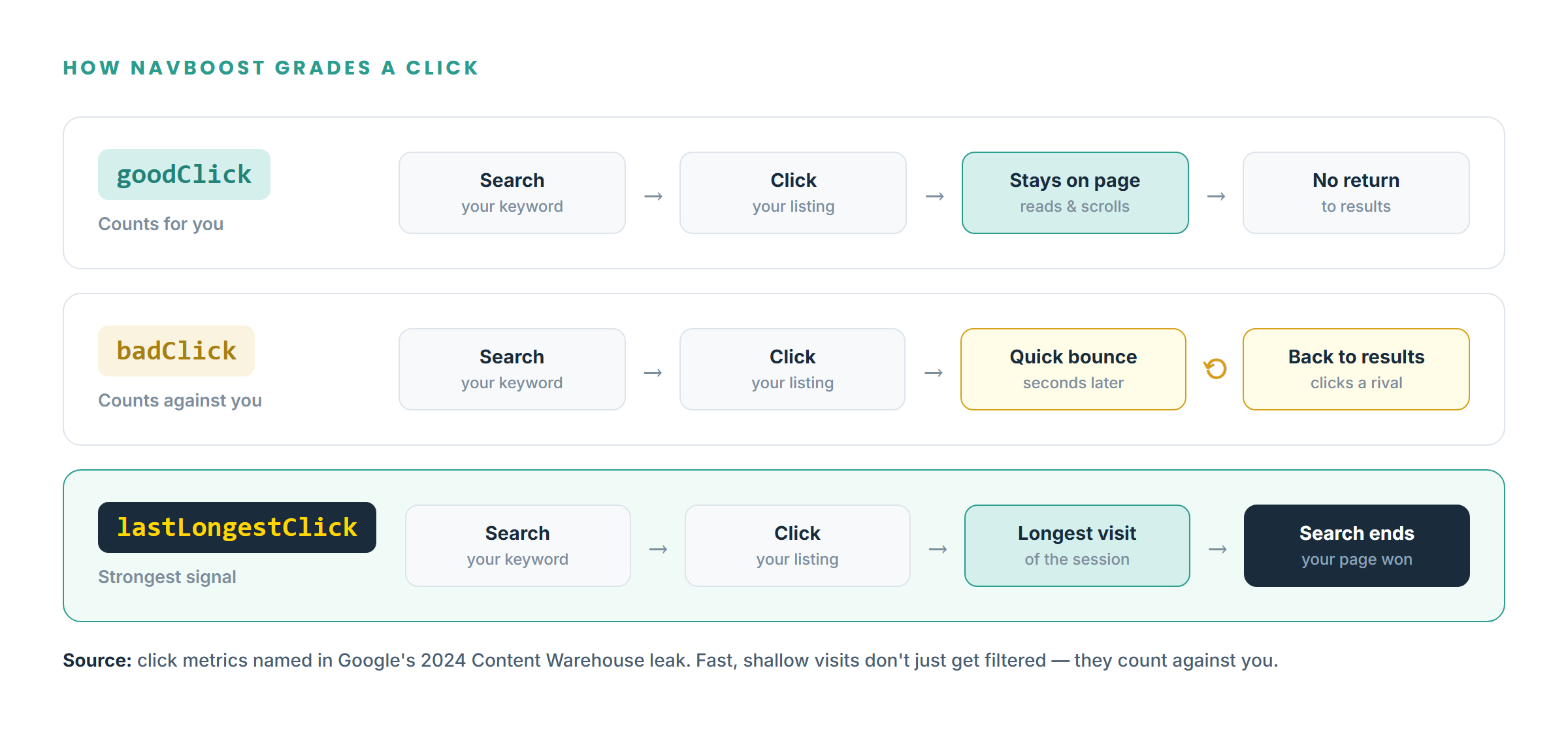
Not all clicks are equal. Navboost distinguishes three kinds of click. A goodClick is a selection that ends well: the searcher clicks your result, stays, and doesn’t return to the results page to try again. A badClick is the opposite — a click followed by a quick bounce back to the results (what SEOs call pogo-sticking). A lastLongestClick is the strongest signal of all: your page was the last one clicked and the one the searcher spent the longest on. Your page ended the search.
The practical consequence: a click that bounces in five seconds isn’t neutral, it counts against you. Any CTR strategy that generates fast, shallow visits is manufacturing badClicks.
The signal accumulates over 13 months. Trial testimony revealed Navboost trains on a rolling 13-month window of click data. This is why click campaigns behave like SEO and not like ads: the signal builds with sustained activity and doesn’t vanish the day you stop, but a two-day burst also won’t rewrite thirteen months of history.
The signal is squashed. Google applies a squashing function to click signals — a curve that flattens extreme values so no single input can run away with the ranking. Ten thousand clicks are not a thousand times better than ten. Volume has diminishing returns; consistency and click quality don’t.
Clicks are re-ranking, not ranking. Navboost operates as one of Google’s twiddlers — systems that re-order results that already qualified on relevance and authority. Click signals decide placement among pages already in the game. They will move a page-two result onto page one; they will not rescue a page with no content and no links. (Full mechanics: How Navboost Works.)
Does CTR manipulation work? The experiments
The Fishkin tests. Rand Fishkin ran the famous public experiments: he asked his followers to search a keyword and click his result, and watched it move from position #7 to #1. When the 2024 leak landed, Fishkin’s reaction was that Google had told the truth to no one and the tests had been right all along.
The Sterling Sky live experiment. In 2026, the local-SEO agency Sterling Sky watched rankings move in real time as clicks came in — a live, documented demonstration on a competitive query, from a firm with no click service to sell.
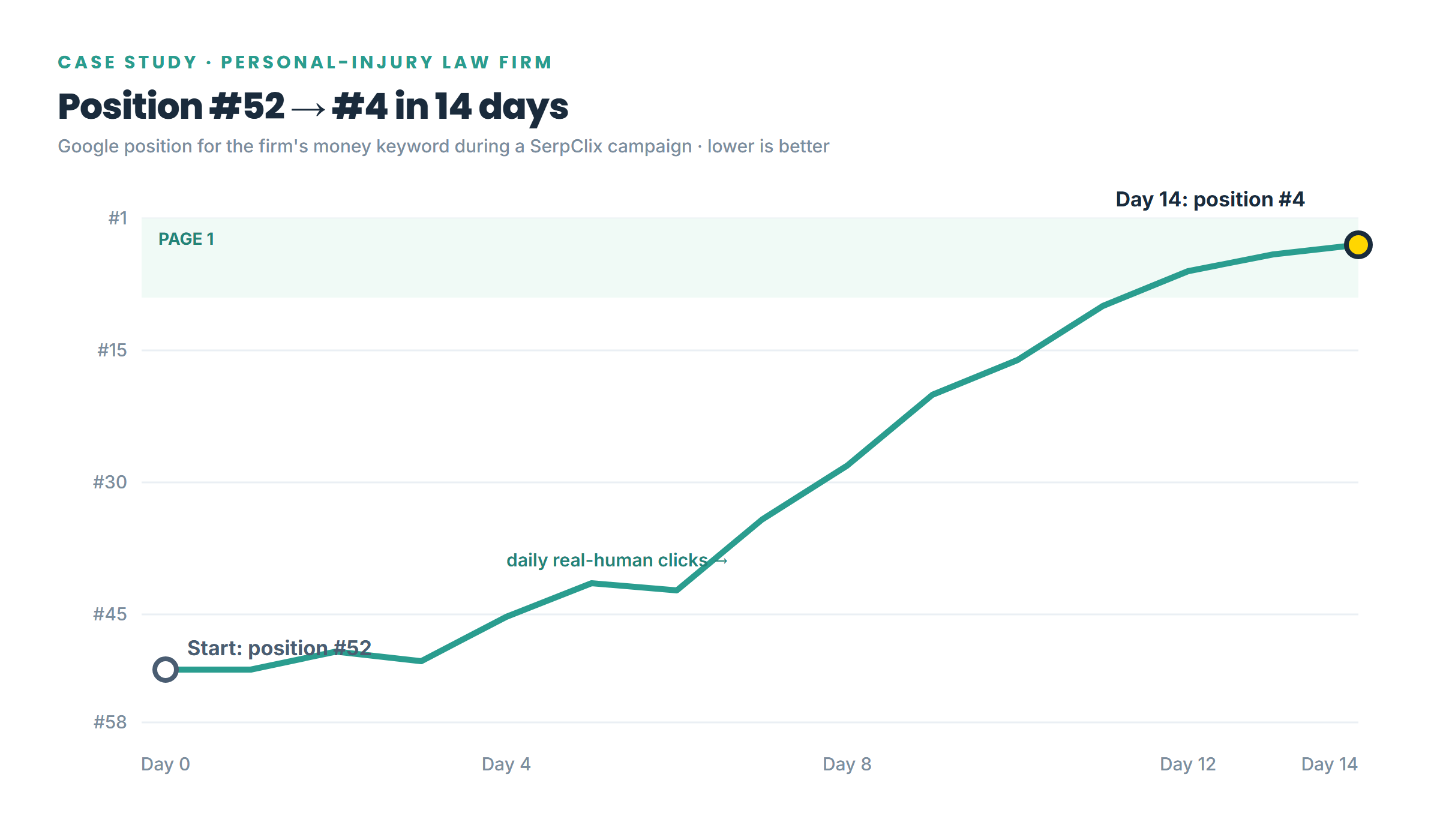
Our case studies. A personal-injury law firm moved from position #52 to #4 in 14 days on its money keyword. An agency campaign moved 7 of 7 target URLs up. Another customer’s tracked keyword set improved from an average position of 4.7 to 1.7. Full write-ups with Search Console screenshots are in our case studies.
Honest counterweight: results vary, and anyone who tells you otherwise is selling a guarantee they can’t honor. Some campaigns move in days, some take weeks, and some keywords don’t respond — competition, content quality, and starting position all matter. There are no guarantees in SEO.
The three ways people manipulate CTR
1. Click bots (the cheap way that fails)
A CTR bot is software that loads a results page, clicks a listing, and fakes a visit, usually routed through residential proxies to disguise its origin. Bot services charge $0.01–$0.04 per click, and nearly all of them market the traffic as “real human clicks.”
Run the math on that claim. A real search-and-click takes minutes of a human being’s attention, and that human expects to be paid. We pay our clickers more per click than most bot services charge their customers in total. A $0.03 click cannot pay a human being — there isn’t even room for the payment processing fee. Either the vendor loses money on every order, or no human is involved.
And bot clicks fail for a structural reason: the entity they need to fool is the most experienced bot-detection operation on earth. Google has defended billions of dollars of ad revenue from click fraud for two decades. Datacenter and proxy IP addresses, clean browsing profiles with no history, uniform session lengths, single-action visits — each is trivially separable from human behavior at Google’s scale. Remember what the leak showed: Google doesn’t just count clicks, it grades them. A filtered click is wasted money; a graded-bad click is worse. We wrote the full teardown in Traffic Bots Are Not Your Friend.
2. Real human clickers (the way that works)
The alternative is having real people perform real searches. This is the model SerpClix pioneered: a crowdsourced network of 400,000+ clickers who search your keyword on their own devices, on their own home internet connections, find your listing, click it, and spend time on your page.
Measured against every signal in the leak, this is what genuine demand looks like, because it is genuine behavior:
Residential IP addresses from real ISPs — no proxies, no datacenters. Real browser profiles with real histories and cookies, many logged into their own Google accounts. Genuine search behavior — an actual query, a scroll through the results, a click, then time on your page reading and scrolling, which is what generates goodClicks and lastLongestClicks instead of bounces. Natural variation — hundreds of different people click at different speeds from different places, which no script reproduces. (Worried about the visit lengths? See Will SerpClix Increase My Bounce Rate?)
3. Organic CTR optimization (do this regardless)
You can also raise your click-through rate the fully white-hat way, by making your listing more clickable. This compounds with everything above — a listing that earns more real clicks per impression is manipulating CTR in the way Google explicitly wants you to:
Title tags written for the click, not just the keyword. Your title competes with nine other results. Specificity, numbers, and a clear payoff win clicks; see the title-tag A/B tests that actually moved rankings and our guide to titles and meta descriptions.
Rich results. Schema markup that adds ratings, FAQs, or how-to steps makes your listing physically larger — rich results capture 58 clicks per 100 searches.
Featured snippets. Structure content to answer the query directly and you can jump the entire ranking with position zero.
How to run a CTR manipulation campaign, step by step
This is the playbook we’d give any new customer, and most of it applies whatever service you use.
Step 1: Pick keywords that can convert their position. The sweet spot is a commercial-intent keyword ranking positions 4–20: close enough that click signals plausibly re-rank you, valuable enough to be worth the spend. Page-one-bottom to page-two is where re-ranking systems do their work. (How to choose: picking keywords worth targeting.)
Step 2: Size the click volume to the keyword. The goal is a click-through rate meaningfully above what your position predicts — not a firehose. A keyword searched 500 times a month does not receive 200 extra clicks a week from genuine demand, and the squashing function means overkill buys nothing anyway. Start conservative, relative to the keyword’s real search volume.
Step 3: Match the searcher to the market. Clicks should come from the country (for local intent, the region) your real customers search from. A Denver plumber receiving clicks from abroad is generating noise at best.
Step 4: Run it like a campaign, not an event. Daily clicks over weeks beat a burst. The 13-month window rewards sustained signals; our case-study movements happened across two-to-six-week campaigns, not overnight.
Step 5: Measure in Search Console, not vibes. Baseline your keyword’s position and CTR before starting. Annotate the start date, watch average position weekly, and separate branded from non-branded queries so brand growth doesn’t pollute the read. Real-human clicks appear in your own Analytics as normal traffic — which is itself the easiest vendor-honesty test there is: if a service’s clicks don’t show up in your Google Analytics, Google has already filtered them.
Step 6: Iterate. When a keyword reaches its target, hold or taper and reallocate to the next one. When nothing moves in six weeks, the keyword is usually too competitive for its content — fix the page, then re-run.
CTR manipulation for local SEO and Google Maps
Click behavior is, if anything, more powerful in the map pack — behavioral signals are the fastest-rising local ranking factor, and the Sterling Sky experiment above was a local test. Searches that end in a click on your Google Business Profile, driving-direction requests, and website clicks from Maps all feed local rankings. SerpClix supports Google Maps clicks natively; if local is your fight, start with our local SEO page and check your standing with the free Maps ranking checker.
What AI Overviews change
The biggest shift since this guide was first published is the results page itself. Google now answers many informational queries with an AI Overview at the top, and those answers absorb clicks that used to reach the listings: organic CTR drops 61% on queries where an Overview appears, and position #1’s CTR fell 32% in a single year.
Two consequences for everything in this guide. First, each click is worth more: when fewer clicks flow through a results page, each one carries more relative weight in a system that ranks by click behavior. Second, the keywords worth defending are commercial: AI Overviews dominate informational queries, while searches with buying intent still send people to websites — and those are the queries where rankings translate into revenue. Concentrate click signals there.
Risks and common questions
Will Google penalize my site? It is highly unlikely. If incoming clicks could trigger penalties, any competitor could tank your rankings with a $50 bot order — the same reason Google stopped penalizing sites for unnatural incoming links they didn’t build. Google’s documented approach is to filter signals it distrusts, not punish the site receiving them. The real risk of a bad CTR service is simpler: you pay for clicks that get filtered (or graded as badClicks) and nothing happens.
Is this black-hat SEO? It’s gray. Google doesn’t endorse it; Google also can’t distinguish a paid real-human click from an organic one, because behaviorally there is no difference. Where you draw the line is your call — our position is transparency about exactly what you’re buying: real people, really searching, really clicking.
How fast are results? Days for some campaigns, weeks for most, never for some keywords. Anyone promising guaranteed rankings on a schedule is describing software, not search.
Do I still need regular SEO? Yes. Click signals re-rank pages that already qualify. Thin content with no links stays where it deserves to be, with or without clicks.
The bottom line
CTR manipulation works when it’s done right. “Done right” means real human clickers with genuine IP addresses and natural behavior, click volumes matched to real search volume, campaigns that run for weeks on commercial keywords, and strong fundamentals underneath. The evidence is no longer the debate — Navboost is documented under oath, the leak names the metrics, and a federal court called the click data essential. The question isn’t whether CTR matters. It’s whether you’re doing anything about it.
SerpClix is the original real-human click marketplace — 400,000+ clickers, in operation since 2016. Check where you rank — in Google and in AI results — with the free rank checker, then start your free trial or log in to your dashboard.
See also: For an independent, evidence-based look at whether CTR manipulation actually works — and when it fails — see the analysis on NavBoost.com.
Please note: there are no guarantees in search engine optimization, ever. There are innumerable factors that can affect search engine rankings. All SEO efforts can involve an element of risk. SerpClix employs real human clickers, so we think our service is far less risky than trying to use automated or robotic click methods. But, like all SEO strategies, there is an element of risk because Google’s algorithm is unknown and subject to change at any time. For more information please see our FAQs.
Recommended SerpClix services
We send real human visitors from our network to your pages, so search engines see genuine engagement. Start with the service that fits what you're working on.