
Buy Organic Traffic: Real Human Clicks That Boost Your Rankings
SerpClix connects you with over 400,000 real human clickers who search your keywords on Google, click your organic listing, and stay on your site for meaningful time. The result? Higher click-through rates, stronger ranking signals, and sustainable organic traffic growth — without paying for ads.
Start Your Free Trial →What Does It Mean to Buy Organic Traffic?
Most website owners think of organic traffic as something you earn through months of content creation, link building, and technical SEO. And while those fundamentals still matter, there is a more direct path to growing your organic search visibility: buying real organic traffic from actual human searchers.
When you buy organic traffic through SerpClix, you are not purchasing bot visits, ad clicks, or fake pageviews. You are paying real people — over 400,000 of them across 160+ countries — to search your target keywords on Google, find your listing in the organic results, click on it, and stay on your page for a meaningful amount of time.
This matters because Google's ranking algorithm heavily weighs how users interact with search results. When more people click your listing and engage with your content, Google interprets this as a strong relevance signal. The result is improved organic rankings that persist even after your campaign ends.
Think of it this way: traditional SEO is like building a reputation over years. Buying organic traffic through SerpClix is like introducing your best content to the right audience at the right time, so Google can see what your pages are truly worth. One approach does not replace the other — they work together.
For businesses frustrated by the slow pace of traditional SEO, or those competing against established domains with years of accumulated authority, buying organic search traffic provides a measurable, evidence-based method to accelerate ranking improvements through genuine user engagement.
Unlike generic website traffic services that send direct visits from unknown sources, organic traffic from SerpClix originates within Google's search results. Every click is registered by Google as a real organic interaction, which is why it influences rankings while other traffic sources do not.
How Click-Through Rate Affects Organic Rankings
The connection between click-through rate and organic rankings is not speculation — it is one of the most well-documented dynamics in search engine optimization. Multiple studies, patents, and leaked internal documents confirm that Google actively uses engagement signals to determine which pages deserve higher positions.
The Evidence: CTR as a Ranking Signal
Rand Fishkin's widely cited experiment demonstrated that a burst of targeted clicks could move a page from position #7 to position #1 within hours. The Sterling Sky CTR experiment replicated similar results in a local SEO context, showing that clicks directly influenced Google Maps rankings. Academic research has consistently found a strong correlation between CTR and organic rankings, even after controlling for position bias.
These are not isolated findings. They represent a body of evidence spanning over a decade that points to the same conclusion: Google rewards listings that attract and satisfy searchers.
Google's NavBoost Algorithm: The Confirmed Mechanism
In 2023, leaked internal Google documents and court testimony in the DOJ antitrust trial confirmed what the SEO community had long suspected: Google uses a system called NavBoost to adjust rankings based on user click behavior. NavBoost analyzes click patterns on search results — which listings users click, how long they stay, and whether they return to click a different result (known as "pogo-sticking").
According to the leaked documentation, NavBoost has been part of Google's ranking system for over 13 years, and it is considered one of the most important signals in the entire algorithm. The court proceedings forced Google to acknowledge what practitioners already knew: user click behavior directly influences rankings.
When you buy organic traffic through SerpClix, you are directly feeding positive signals into NavBoost. Real users click your listing, stay on your page for extended time, and do not return to the search results to click competitors. These are precisely the signals NavBoost uses to promote pages in the rankings.
Dwell Time and User Satisfaction Signals
Getting the click is only half the equation. Google also measures what happens after the click. If a user clicks your result and immediately bounces back to the search results, that sends a negative signal. But when a user stays on your page and engages with your content, Google interprets this as confirmation that your result satisfied the query.
SerpClix clickers stay on your page for extended time, browsing naturally. This creates exactly the kind of positive engagement signal that Google's algorithms are designed to reward. The combination of high CTR and meaningful dwell time is what makes buying organic traffic through SerpClix so effective at moving rankings.
For a deeper look at the mechanics behind this approach, our comprehensive guide on CTR manipulation covers the research, the evidence, and practical implementation strategies.
Ready to Boost Your Organic Rankings?
Join thousands of SEO professionals who use SerpClix to drive real human clicks to their organic listings.
Start Your Free Trial →Organic Traffic vs Bot Traffic: Why the Difference Matters
The market for "buying traffic" is crowded with services that promise thousands of visitors for a few dollars. The vast majority of these services deliver bot traffic — automated scripts, headless browsers, or datacenter proxies that simulate human visits. Understanding why this distinction matters is critical to making an informed purchasing decision.
How Bot Traffic Works (and Fails)
Bot-based traffic services use automated software to visit your website. Some use simple HTTP requests that never render your page at all. Others use headless browsers like Puppeteer or Selenium to simulate a browser environment. The more sophisticated ones rotate through proxy servers and attempt to mimic human behavior patterns.
The problem is that Google has invested billions of dollars into detecting exactly this kind of artificial activity. Google's systems can identify bot traffic through dozens of signals: consistent timing patterns, missing browser fingerprints, datacenter IP ranges, lack of natural mouse movements, identical viewport sizes, missing JavaScript execution patterns, and more.
When Google detects that clicks on your listing are artificial, it discards those signals entirely. In some cases, a pattern of bot clicks can actually harm your rankings by triggering Google's spam detection systems. You are not just wasting money — you may be actively damaging your site.
How SerpClix Organic Traffic Works
SerpClix takes the opposite approach. Every click comes from a real person using their own browser, on their own device, with their own residential IP address. The clickers are spread across 160+ countries, use different operating systems and browsers, and search at different times throughout the day.
There is nothing to detect because there is nothing artificial happening. A real person opens Google, types a keyword, scrolls through the results, clicks your listing, and reads your page. The behavioral signals — variable scroll speeds, natural mouse movements, genuine page interaction — are authentic because the user is authentic.
This is the fundamental reason why SerpClix produces ranking improvements while bot services do not. Google's entire ranking system is built to reward genuine user engagement. The only way to reliably generate those signals is with genuine users.
| Signal | SerpClix (Real Humans) | Bot Traffic Services |
|---|---|---|
| Real browser fingerprint | ✓ | ✗ |
| Residential IP addresses | ✓ | ✗ |
| Natural mouse/scroll behavior | ✓ | ✗ |
| Variable dwell time (60s+) | ✓ | ✗ |
| Genuine search session | ✓ | ✗ |
| Diverse devices and OS | ✓ | ✗ |
| Passes Google's bot detection | ✓ | ✗ |
| Influences rankings | ✓ | ✗ |
How SerpClix Delivers Real Organic Traffic
SerpClix has refined its organic traffic service over years of operation, building a global network of over 400,000 real human clickers and developing a system that produces consistent, measurable ranking improvements. Here is how the process works:

Step 1: Set Up Your Campaign
Enter your target keyword, your URL, the search engine (Google, Maps, YouTube, or Bing), and how many clicks you want per day. Choose your target country from 160+ options and select your preferences.
Step 2: Real People Search Your Keywords
SerpClix distributes your order to real human clickers who open Google in their own browser, type your keyword, and scroll through the organic search results — just like any normal searcher would.
Step 3: Clickers Find and Click Your Listing
The clicker locates your URL in the organic results and clicks on it. This click is registered by Google as a genuine organic interaction, feeding positive CTR signals into the ranking algorithm.
Step 4: Extended Engagement on Your Page
After clicking, the clicker stays on your page for extended time, interacting naturally with your content. This sends strong dwell time and satisfaction signals that reinforce the positive CTR data.
Step 5: Track Results and Optimize
Monitor your campaign through the SerpClix dashboard. Track clicks delivered, average dwell time, and ranking changes over time. Adjust campaigns based on performance data to maximize your organic traffic growth.
The entire process uses real people on real devices with real IP addresses. There are no bots, no browser emulators, no headless browsers, and no proxies. This is what separates SerpClix from every other organic traffic service on the market.
Buying Organic Traffic vs Paid Ads: A Side-by-Side Comparison
Many businesses default to Google Ads when they need more search traffic. Paid ads have their place, but for businesses seeking sustainable growth, buying organic traffic through SerpClix offers advantages that paid advertising cannot match.
| Factor | SerpClix Organic Traffic | Google Ads |
|---|---|---|
| Traffic type | Organic click traffic | Paid ad traffic |
| Lasting impact | Rankings persist after campaign | Traffic stops when budget runs out |
| User trust | Organic results get 70%+ of clicks | Many users skip ad results |
| Cost trajectory | Decreases as organic rankings improve | CPCs increase in competitive markets |
| Click quality | Real human engagement signals | Traffic but no ranking benefit |
| Competitor bidding | Not affected by bid competition | Competitors can drive up your costs |
| Compounding returns | Higher rank = more free organic clicks | No compounding effect |
The key distinction is compounding value. Every dollar you spend on Google Ads produces traffic only for as long as you keep spending. Every dollar you invest in buying organic traffic through SerpClix contributes to ranking improvements that continue to drive free organic clicks long after the campaign ends.
This does not mean paid ads are never appropriate. For immediate visibility, new product launches, or testing keyword viability, Google Ads serve a clear purpose. But for building sustainable organic search visibility, buying SEO traffic through real human clicks offers a fundamentally better return on investment over time.
Stop Renting Traffic. Start Building Rankings.
See why thousands of SEO professionals choose SerpClix over ads-only strategies. Free 7-day trial, plans from $197/month.
Start Your Free Trial →The CTR Flywheel: How Buying Organic Traffic Compounds Over Time
One of the most powerful aspects of buying organic traffic is the compounding effect it creates. We call this the CTR flywheel, and understanding it is key to seeing why this strategy delivers outsized returns compared to other traffic acquisition methods.
How the Flywheel Works
Here is the sequence: You buy organic traffic through SerpClix, which increases your click-through rate for your target keywords. Google's NavBoost algorithm detects the improved engagement signals and moves your listing higher in the rankings. A higher position naturally attracts more organic clicks from real searchers who are not part of SerpClix. Those additional natural clicks further reinforce the positive ranking signals, sustaining or even improving your position.
Over time, the organic clicks you earn naturally can partially or fully replace the clicks you originally purchased. This is why many SerpClix users find they can reduce their campaign volume after the initial ranking improvement — the flywheel sustains itself through genuine organic engagement.
Why Backlinks Alone Are Not Enough Anymore
For years, backlinks were considered the dominant ranking factor. While they still matter, engagement signals are gaining weight relative to traditional link-based metrics. Google's own internal documents suggest that user behavior data, processed through systems like NavBoost, can override link-based signals in determining final rankings.
This shift means that a page with fewer backlinks but stronger engagement signals (high CTR, long dwell time, low pogo-sticking) can outrank a page with more links but weaker engagement. Buying organic traffic through SerpClix directly addresses this shift by building the engagement signals that modern Google increasingly prioritizes.
The Practical Implication
The flywheel effect means that buying organic traffic is not an ongoing expense in the way that paid advertising is. It is an investment that, when executed well, creates self-sustaining ranking improvements. You invest in clicks to reach a higher position, and the higher position generates enough natural clicks to maintain or improve your ranking without continued spending at the same level.
What Makes SerpClix the Best Organic Traffic Service?
The organic traffic market is filled with services that promise results but rely on bots, proxies, or recycled datacenter traffic. SerpClix is fundamentally different in ways that directly affect whether your investment produces ranking improvements or gets ignored by Google.
- 400,000+ real human clickers — not bots, not browser emulators, not scripts. Every click comes from a genuine person.
- Own devices, residential IPs — clickers use their own computers and phones with home internet connections. No datacenter IPs, no proxies.
- 160+ countries supported — target organic traffic from specific geographic markets. Essential for businesses serving regional audiences.
- Real Google searches — clickers open Google, type your keyword, and click your organic listing. The click happens within the search results, so Google registers it as organic engagement.
- 60+ second dwell time — every click includes meaningful page engagement, sending strong satisfaction signals to Google's ranking algorithm.
- Multiple search engines — support for Google Search, Google Maps, YouTube, and Bing.
- Full campaign dashboard — track clicks delivered, dwell time, ranking changes, and campaign performance in real time.
- Free 7-day trial — test the platform and see results before committing to a paid plan. Plans start at $197/month.
Put simply: SerpClix works because it generates the same engagement signals that organic search users naturally create. There is nothing to detect because there is nothing artificial happening. This is why SerpClix consistently produces ranking improvements where bot-based services fail.
For a detailed comparison of approaches, our guide on organic traffic bots explains why automated solutions cannot match the results of real human clicks.
Real Results: Organic Traffic Growth Case Studies
Data matters more than promises. Here are real results from SerpClix clients who bought organic traffic to improve their rankings and grow their search visibility.
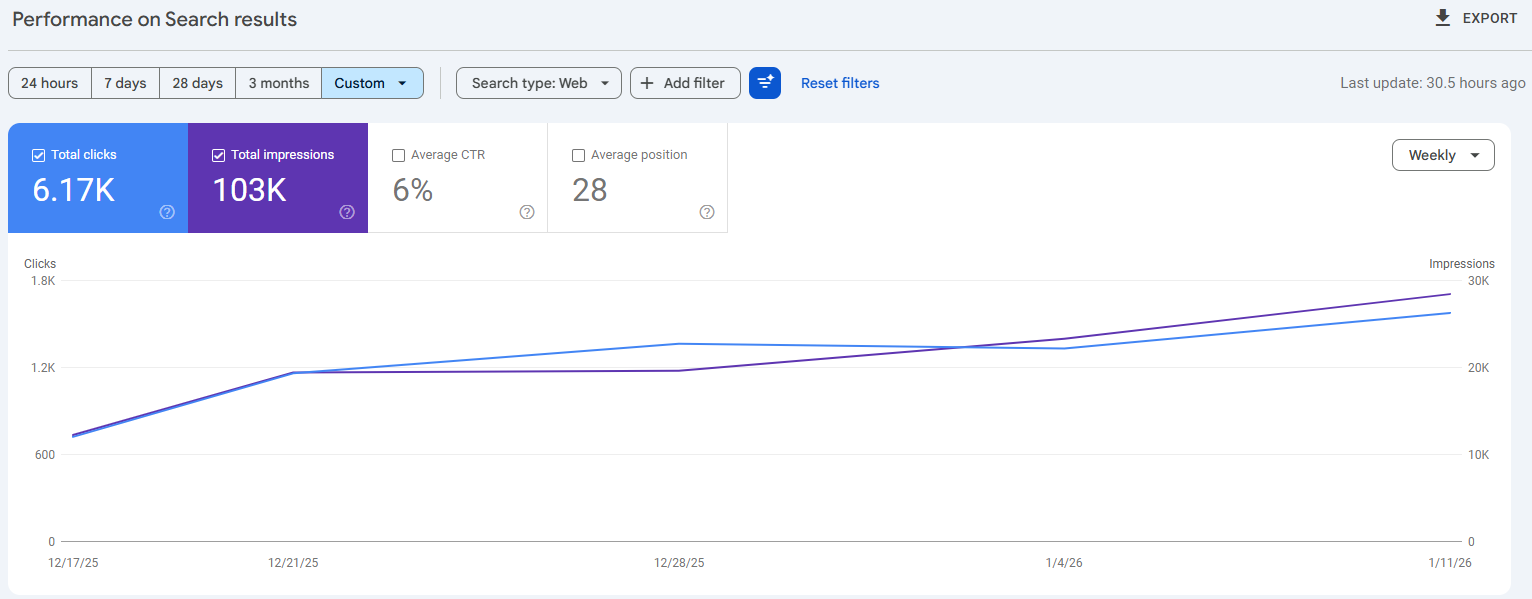
Nova Solutions: 7 URLs Climbing in 13 Days
Nova Solutions, a digital marketing agency, used SerpClix to buy organic traffic for 7 client URLs across competitive niches. Within 13 days, all 7 URLs showed measurable upward movement in Google's organic results. The organic traffic growth was driven entirely by improved CTR signals — no additional backlinks or content changes were made during the test period.
Coreter Media: Position 4.7 to 1.7 in One Week
Coreter Media ran a focused organic traffic campaign targeting a competitive keyword for a client. By buying organic search traffic through SerpClix, they moved the client's listing from an average position of 4.7 to 1.7 in approximately 7 days. The rapid improvement demonstrated the direct impact of CTR signals on Google's ranking algorithm — the page's organic traffic increased substantially as the higher position attracted more natural clicks.
Florida Private Investigator: From Page 6 to Position #1
A Florida-based private investigation firm was stuck at position #52 for their primary keyword — effectively invisible to searchers. After buying organic traffic through SerpClix, the listing climbed from the bottom of page 6 to the #1 organic position in just 14 days. The organic traffic to the site increased dramatically as the business went from receiving virtually zero search clicks to capturing the top position for their most valuable keyword.
See Results Like These for Your Site
Start your organic traffic campaign today. Free 7-day trial — no payment required.
Start Your Free Trial →When Should You Buy Organic Traffic?
Buying organic traffic is not a universal solution for every SEO challenge, but there are specific situations where it is one of the most effective strategies available.
You Are Stuck on Page 2 or 3
If your pages are ranking on page 2 or 3 of Google, they are tantalizingly close to generating real organic traffic but are effectively invisible to most searchers. Fewer than 1% of users ever click past page 1. Buying organic traffic can provide the CTR boost needed to push these pages onto the first page, where they can begin attracting natural clicks.
You Have Strong Content but Weak Engagement Signals
Some pages have excellent content, strong backlinks, and solid technical SEO, but they underperform in rankings because their CTR is below average for their position. This is surprisingly common — a great page with a mediocre title tag, for example, might have the authority to rank well but lacks the click-through rate to prove it. Buying organic traffic solves this by generating the engagement signals your content deserves.
You Are Competing Against Established Brands
Large, well-known brands benefit from higher CTRs simply because of brand recognition. Users tend to click on names they recognize, even if the listing is not in the top position. Buying organic traffic helps level the playing field by demonstrating to Google that your listing is equally relevant and satisfying to searchers.
You Need Faster Results Than Traditional SEO Allows
Traditional SEO tactics — content creation, link building, technical optimization — work, but they often take 6 to 12 months to produce meaningful results. If you need to increase organic traffic on a shorter timeline, buying organic clicks can accelerate the process by immediately improving the engagement signals that Google uses to rank pages.
You Are Launching a New Website or Page
New websites face a chicken-and-egg problem: they need engagement signals to rank, but they need to rank to get engagement. Buying organic traffic breaks this cycle by providing the initial click-through and dwell time data that Google needs to evaluate and properly rank your content.
You Want to Protect Rankings from Competitors
If competitors are actively optimizing their CTR — whether through better title tags, rich snippets, or their own CTR campaigns — your rankings can erode even if your content and backlinks remain strong. Buying organic traffic through SerpClix helps you maintain competitive engagement signals and protect the rankings you have worked to build.
How SEO Agencies Buy Organic Traffic for Client Campaigns
SerpClix is used by SEO agencies worldwide as a core component of their client ranking strategies. The platform's scalability, targeting options, and measurable results make it particularly well-suited for agency workflows.
Supplementing Traditional SEO Campaigns
Most agencies use SerpClix alongside their existing SEO services — content, links, technical audits — to accelerate results for clients. Rather than waiting 6+ months for content and links to produce ranking improvements, agencies can buy organic traffic to start generating positive engagement signals immediately. This delivers faster results to clients, which improves retention and satisfaction.
Targeting Specific Keywords for Quick Wins
Agencies often identify "quick win" keywords — terms where the client ranks on page 2 or low on page 1 — and target those with SerpClix campaigns first. These keywords respond fastest to CTR improvements, allowing the agency to demonstrate value to the client early in the engagement. The Nova Solutions case study is a perfect example: 7 URLs all moving up within 13 days.
Scaling Across Multiple Clients
SerpClix's credit-based system and campaign management dashboard make it straightforward to manage organic traffic campaigns across multiple clients simultaneously. Agencies can allocate credits based on priority, adjust click volumes per keyword, and track results for each client independently.
For targeted traffic campaigns where geographic precision matters — such as a local law firm or regional service provider — agencies can leverage SerpClix's geo-targeting to ensure clicks come from the right market. This is especially valuable for local SEO CTR campaigns where search behavior varies significantly by location.
Running an Agency? SerpClix Scales with You.
Manage organic traffic campaigns across all your clients from a single dashboard. Start your free trial today.
Start Your Free Trial →Advanced Strategies for Buying Organic Traffic
Once you understand the fundamentals, these strategies can help you maximize the impact of your organic traffic campaigns.
Keyword Clustering
Rather than concentrating all clicks on a single keyword, distribute your budget across a cluster of related terms. If your primary target is "buy organic traffic," also run campaigns for "buy organic search traffic," "organic traffic service," and "real organic traffic." This creates a more natural engagement pattern and strengthens your topical relevance across the entire keyword cluster, which Google rewards with broader ranking improvements.
Gradual Ramp-Up
Start with a moderate number of clicks and increase gradually over time. This mimics the natural pattern of growing popularity and creates a more organic-looking engagement curve. A typical approach is to start with 5-10 clicks per day and increase by 20-30% each week as rankings begin to improve.
Combine with On-Page CTR Optimization
Maximize the impact of purchased organic traffic by optimizing the elements that influence natural CTR: title tags, meta descriptions, and structured data. A compelling title tag can increase your natural CTR by 20-30%, which compounds the effect of your SerpClix campaigns. When both purchased and natural clicks are working together, the ranking impact accelerates.
Competitive CTR Analysis
Before launching campaigns, use Google Search Console to analyze your current CTR for target keywords. Compare this against industry benchmarks for your position. This helps you calibrate the right daily click volume to produce a meaningful but natural-looking CTR improvement. The goal is to exceed the expected CTR for your position by 20-50%, which is the range that tends to trigger ranking improvements without appearing anomalous.
Monitor, Adjust, and Scale
Track rankings daily during active campaigns. If your position improves, consider whether you can reduce click volume while maintaining your position — the flywheel effect may sustain rankings at lower volumes. If progress is slow, increase clicks or expand to related keywords. Treat buying organic traffic as an ongoing optimization process, not a one-time purchase.
For a complete guide to building sustainable organic growth, read our overview of SerpClix SEO services and how CTR optimization fits into a comprehensive search strategy.
Pricing, Plans, and Your Free Trial
SerpClix is designed to be accessible for businesses of all sizes, from solo site owners testing organic traffic for the first time to large agencies managing campaigns across hundreds of client sites.
How Pricing Works
SerpClix uses a credit-based system. You purchase credits and use them to order clicks for your target keywords. Plans start at $197 per month, with the cost per click consistently lower than equivalent Google Ads CPCs — especially for competitive keywords where paid CPCs can exceed $10, $20, or even $50 per click.
Free 7-Day Trial
New users can start with a free 7-day trial to experience how buying organic traffic through SerpClix works. The trial gives you full access to the platform: set up campaigns, receive real human clicks, monitor results in your dashboard, and see ranking improvements before committing to a paid plan.
What Every Plan Includes
- Access to all supported search engines (Google, Maps, YouTube, Bing)
- Geo-targeting across 160+ countries
- Extended dwell time per click
- Full campaign dashboard with click tracking and reporting
- Scalable click volumes — from 10 clicks/day to thousands
Whether you need organic traffic for a single keyword or want to scale across hundreds of terms, SerpClix has a plan that fits. Start with your free trial and upgrade as you see the impact on your rankings.
Start Your Free Trial →Frequently Asked Questions
Related Resources
- SEO Services Hub
- SerpClix Alternatives Compared
- Buy Website Clicks
- Buy Targeted Traffic
- Buy SEO Traffic
- Increase Organic Traffic
- CTR Manipulation
- Buy Google Traffic
- Buy Real Website Traffic
- Local SEO CTR
- NavBoost SEO
- CTR Manipulation Guide
- Does CTR Affect Rankings?
- Sterling Sky CTR Experiment
- Organic Traffic Bot Comparison
- Backlinks vs Engagement Signals
- The CTR Flywheel Effect
- NavBoost Click Data Revealed
- How Agencies Use SerpClix
Start Buying Organic Traffic That Actually Works
Join over 400,000 users and thousands of SEO professionals who trust SerpClix to deliver real human clicks that improve organic rankings. No bots. No ads. Just real people, real searches, and real results.