
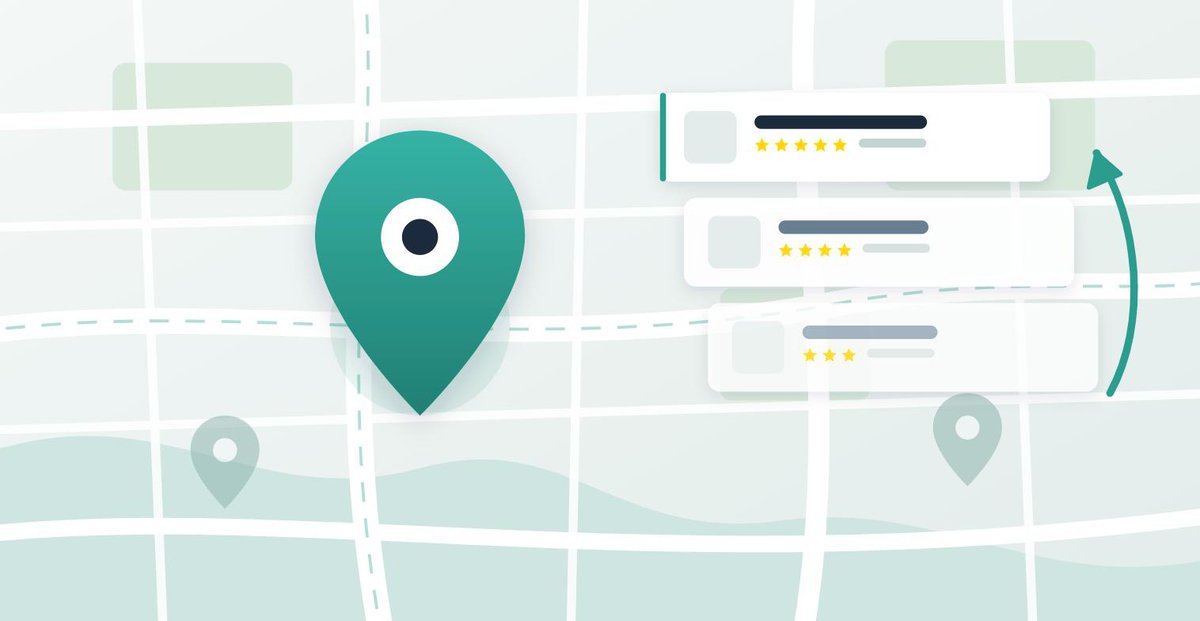
Ranking higher on Google Maps is one of the highest-return marketing projects a local business can take on — the top three listings collect most of the clicks, calls, and direction requests for any local search. It’s also drowning in advice, much of it recycled and some of it flat wrong.
This guide covers what Google has actually told us about local rankings, in the order you should work on it. We’ll be honest about which levers are heavy, which are light, and which one almost every guide skips.
First, a baseline: before you change anything, know where you stand. Our free Google Maps rank checker shows your live position for any search phrase in about ten seconds. Check your three or four most valuable “service + city” phrases and write the numbers down — you’ll want the before picture.
How Google ranks Maps results: three factors
Google is unusually direct about this. Local results rank on three things:
• Relevance — how well your listing matches what was searched.
• Distance — how far you are from the searcher (or the location in the search).
• Prominence — “how well known a business is,” in Google’s words, drawing on information from across the web and on how people interact with your listing.
You can’t move your building, so distance is fixed. Relevance is necessary but nearly binary — either your listing correctly says what you do or it doesn’t. Which means once the basics are right, local rankings are a prominence contest. Keep that frame; everything below feeds one of the three.
Step 1: Complete your Google Business Profile — actually complete it
Unheroic, unavoidable. Google fills the local pack from Business Profiles, and incomplete profiles rank worse because there’s less for relevance to match on.
• Verify the profile. Unverified means invisible.
• Fill in every field: hours (including holidays), phone, website, services, service area, attributes, opening date.
• Add real photos — the storefront, the team, the work. Listings with active photos get measurably more engagement, and engagement feeds prominence.
• Post occasionally. Not because posts rank you directly, but because an active profile earns more interaction than a dead one.
Step 2: Get your primary category right
The single most load-bearing relevance decision. Your primary category (“Personal injury attorney,” not “Lawyer”; “Emergency plumber,” not “Plumber” — as specific as truth allows) is the strongest statement of what searches you belong in. Add secondary categories for real service lines, and resist stuffing aspirational ones — a category you can’t back up with reviews and services dilutes more than it adds.
Look at what categories the businesses currently in the top three use. Our rank checker makes it easy to see who those businesses are for each phrase.
Step 3: Reviews — volume, velocity, and replies
Reviews are the most visible prominence signal, and Google says openly that review count and score factor into local ranking.
What works:
• Ask every happy customer, at the moment they’re happy. A steady drip beats a burst — velocity matters, and a profile that got 40 reviews two years ago and nothing since reads as declining.
• Keywords in reviews help. You can’t (and shouldn’t) script customers, but asking “would you mention which service we did for you?” is fair and effective.
• Reply to everything, including the bad ones — calmly and specifically. Replies are engagement, and future customers read them.
What doesn’t: buying reviews. Google filters them, competitors report them, and the FTC fines for them. One faked batch can cost you every real review you’ve earned.
Step 4: Citations and consistency
Google cross-references your name, address, and phone number (NAP) across the web — directories, data aggregators, social profiles, industry sites. Inconsistencies (old address, tracking phone numbers, “St.” vs “Street” chaos across major listings) erode trust in the data.
Get the top 20–30 citations right and consistent. Beyond that, this lever flattens fast — citation-building is the most oversold service in local SEO. It’s hygiene, not fuel.
Step 5: Your website still matters
The profile ranks, but Google reads your linked website for relevance and prominence. A thin one-pager underperforms:
• A dedicated page per core service, in customer language (“water heater replacement in Round Rock,” not “solutions”).
• Standard local schema, embedded map, consistent NAP.
• The normal rules of organic SEO apply — links to your site feed local prominence too.
Step 6: The signal most guides skip — what searchers do with your listing
Here’s the part of “how people interact with your listing” that most local SEO advice never operationalizes: behavior is a ranking input. When searchers see a set of Maps results and consistently click one listing — call, tap for directions, click through to the website — Google learns that this listing is what people searching that phrase want.
This isn’t a theory. Google’s engineers confirmed in the 2023 antitrust trial that click data feeds rankings (“Pretty much everyone knows we’re using clicks in rankings” — Eric Lehman, under oath). The 2024 leak of Google’s internal documentation showed engagement signals threaded through ranking systems, including local. And Sterling Sky’s controlled local CTR experiment moved Maps rankings with clicks alone.
Steps 1–5 make your listing worth choosing. This step is about being seen to be chosen. Options, from slow to direct:
• Earn it organically: a compelling business name you legitimately hold, photo quality, review score — the things that make a searcher pick you out of three. Slow, compounding, worth doing.
• Send it directly: this is what SerpClix does. Real human clickers — over 400,000 of them, on real devices and residential IPs — search your target phrase, find your listing in the Maps results, and click it. That’s the exact behavioral pattern prominence is built on, produced by real people. A Florida business used this to go from position 52 to position 4 in 14 days (case study); the mechanics for local campaigns are here.
The honest caveats, because we’d rather over-disclose: there are no guarantees in SEO — behavioral signal is one factor among several, and it multiplies the fundamentals above rather than replacing them. If your profile is half-empty and your reviews are hostile, fix that first. Clicks make a good listing win; they don’t make a bad listing good.
Step 7: Measure, then iterate
Local rankings move — seasonally, after algorithm updates, and whenever a competitor gets busy. Working blind wastes most of the effort:
1. Pick your 3–5 money phrases (“service + city,” the way customers type them).
2. Check positions monthly with the free rank checker — weekly during an active push.
3. Watch your Business Profile’s own metrics (searches, views, calls, direction requests) for the demand side.
4. Double down where you’re at position 4–10; those are the winnable fights.
The order of operations, summarized
1. Verify and truly complete the Business Profile.
2. Nail the primary category.
3. Build steady review velocity and reply to everything.
4. Clean up your top citations, then stop.
5. Give each core service a real page on your site.
6. Strengthen behavioral signals — earned and, if you want the direct lever, sent.
7. Measure monthly and push where you’re close.
Most of your competitors will do steps 1–4, badly. Almost none of them are working on step 6. That’s the gap.
Good luck with your SEO!
SerpClix uses an army of over 400,000 real human clickers to boost your organic CTR. Get started with a free trial or log in to your dashboard to set up your next click order.
Please note: there are no guarantees in search engine optimization, ever. There are innumerable factors that can affect search engine rankings. All SEO efforts can involve an element of risk. SerpClix employs real human clickers, so we think our service is far less risky than trying to use automated or robotic click methods. But, like all SEO strategies, there is an element of risk because Google’s algorithm is unknown and subject to change at any time. For more information please see our FAQs.
Recommended SerpClix services
We send real human visitors from our network to your pages, so search engines see genuine engagement. Start with the service that fits what you're working on.